Justin Jefferson: The ADP Price Tag Doesn’t Match the Risk
Justin Jefferson is going off the board as a top-10 pick in nearly every format this summer, and on name recognition alone, that makes sense. He is one of the most talented receivers in football and has spent his entire career in the conversation for the game’s best. But drafting at ADP 9 to 11 means paying for production, not potential, and the numbers say Jefferson has not come close to justifying that price for an entire season.
The historical gap is significant
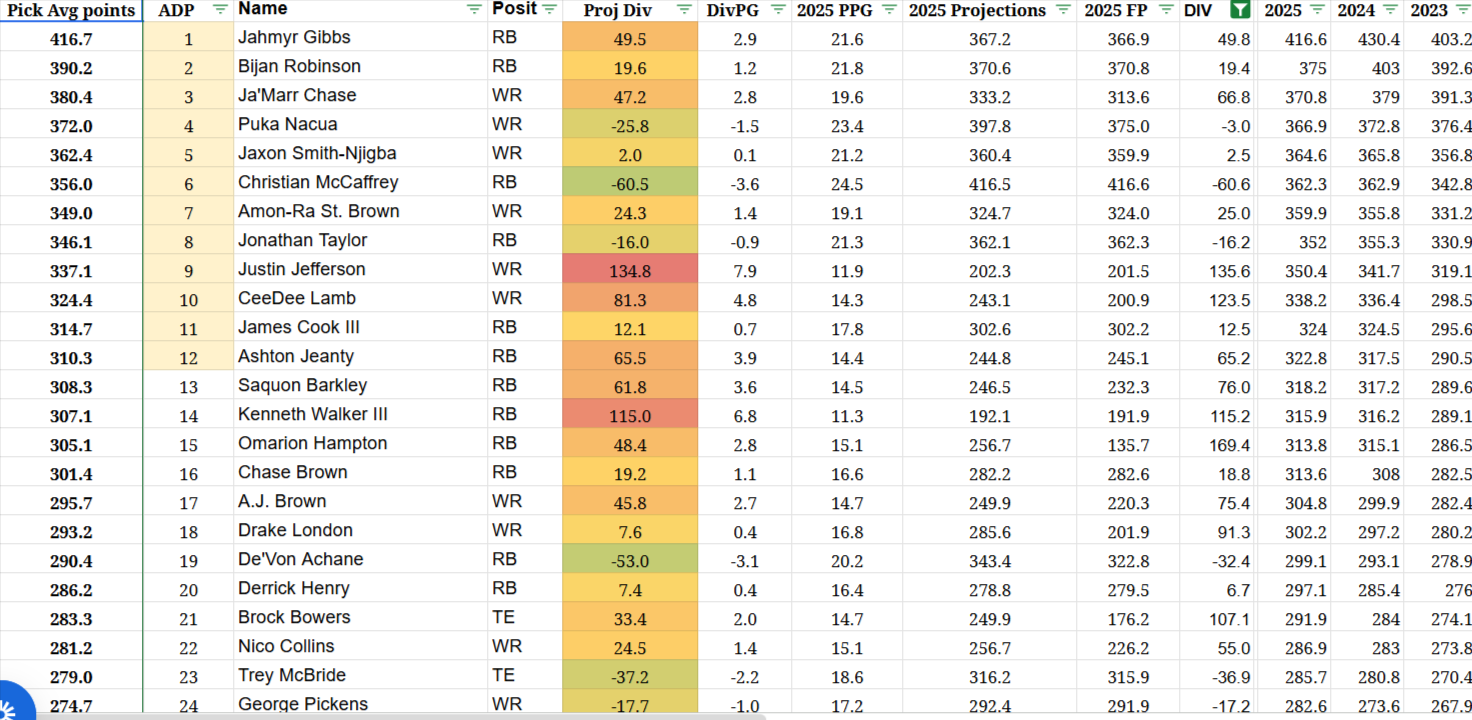
What am I looking at?
The image above shows the average expectation for a draft pick based on historical averages. Instead of drafting players, draft the expected fantasy output of that pick. MoneyBall at its purest form. You’re not drafting a player; you’re drafting an expected fantasy point total.
- The 2025 Projection column is the average based on PPG over a full season.
Over the last three years, the average player selected at pick 9 has returned roughly 337 fantasy points in PPR scoring. Jefferson finished 2025 with just 201, a shortfall of more than 130 points. That is not a marginal miss; it is one of the largest gaps between draft slot and production anywhere in the first two rounds. To simply break even on this pick, Jefferson needs to improve by nearly 70 percent over last season’s output. That is a lot to ask of any player, even one with his talent level.
It was not just bad luck
The easy explanation is quarterback play, and there is real truth to that. Minnesota’s passing offense finished bottom-four in the league in 2025, with its quarterbacks combining for just 17 touchdowns and 21 interceptions on the season. Jefferson caught only two touchdowns all year despite seeing 141 targets, an outcome that would normally scream touchdown regression in his favor for the following season.
But the full picture is messier than “the quarterbacks were bad, so Jefferson will bounce back.” His per-route numbers declined as well; he slid to 36th in separation score and 38th in route win rate among qualifying receivers, and he was tied for the sixth-most drops in the league. Some of that is almost certainly downstream of erratic quarterback play affecting timing and rhythm, but it is not a clean, single-cause story. There is enough here to at least ask whether age, or simply a bad year across the board, played some role alongside the quarterback situation.
The fix is not installed yet
The Vikings’ answer to their quarterback problem is Kyler Murray, signed to a one-year deal after his release from Arizona. On paper, Murray has shown he can support a true No. 1 receiver; he peppered DeAndre Hopkins with over 150 targets in one season, helping Hopkins to a WR7 finish. That is a real reason for optimism.
The problem is that Minnesota has not committed to Murray as the starter. Head coach Kevin O’Connell has repeatedly declined to